09 May 2009
Swine Flu & Coffee
I'm spending the morning at my favorite coffee shop, Wayne's Coffee, which is conveniently located right across the street from my apartment. It provides the perfect combination of factors which make an ideal coffeeshop: free internet, minimal smoke, lots of outlets, and employees who generally leave you alone. Today is a bit of an exception when it comes to the last factor, but I don't mind.
The guy at the counter and I had a mini-drama about honey for my tea...they didn't have any out on the counter, so he went to look for more in the back. He reported that the bulk package of honey was frozen. He put it in hot water to thaw. The prognosis wasn't looking good. This information trickled in as updates in 5-minute intervals which he'd trot over to my table to provide.
Finally, we had success with the honey, and he came over to me with a large jar and a spoon, from which I scooped just enough for my tea. Hooray!
Then we started talking. Turns out he's from Mexico, and has been here for over a year working on his thesis for school (I had noticed a strange accent, but didn't think much of it). He said it's great to meet another North American.
We commiserated about the situation in our homeland, and about how Poles are wary of us. I told him that our clients don't want us coming into the office directly after arriving from the US after our periodic trips home. They've asked us to self-quarantine for 1-2 days before coming into the office. Fair enough, I suppose.
He told me that customers here often ask where he's from, and these days jump back a little when he says he's from Mexico. Once he assures them he hasn't been to Mexico in 4 months, they relax.
Who knew that in coming to Warsaw, the most discrimination I'd feel stems from my being from New York? And that swine flu would be something over which an American and a Mexican could bond, all the way out in Warsaw?
05 May 2009
Slate on Starbucks
I wasn't the only American to comment on the arrival of Starbucks in Warsaw.
A Slate writer provides some interesting observations:
Full text here.
A Slate writer provides some interesting observations:
The arrival of McDonald's in Warsaw in the early 1990s signified for many the arrival of capitalism in Poland. The arrival of Starbucks in Warsaw, as in Prague, Czech Republic (it got there a few months ago), and possibly Budapest, Hungary (where it's been promised for years), signifies the entry of Central Europe not just into the capitalist world but into the world of 21st-century-style prosperity.
Full text here.
08 April 2009
Starbucks in Warsaw - Believe It!
Hot off the presses: Starbucks opened its first store in Poland this morning. The inaugural store, in Warsaw at Nowy Świat 62, has been in the works for 2 years.
I made haste in getting myself over there for my first Polish Starbucks latte. It was pretty crowded, with TV crews and a crowd of customers (both Polish and International). The employees were practically giddy - the clearly understand what a Big Deal this is.
It's quite the challenge, I imagine, to find the perfect balance between staying true to the Starbucks brand and appealing to local taste. Another American and I bemoaned the lack of scones (particularly the crack-laced Maple Oat Nut Scone), but we also understood that scones aren't really eaten in Poland. So should Starbucks take it upon itself to bring the wonders of the scone to Poland, or should it just sell them what they want? I pondered a similar quandry in an earlier entry.
From an American's perspective, I think Starbucks succeeded. Entering the store felt like coming home (I know, I know...but you see I have intense love for Starbucks). We'll see how it is received by the locals. The Suits from Seattle are surely keeping a close watch on this high growth-potential market.
05 April 2009
A Variation
This was the first real week of Spring weather in Warsaw, and to celebrate, some friends and I went on a long bicycle around the city.
At one point we reached a park with a bit of a hill. I'll blame being in the wrong gear, rather than my poorly toned muscles, but I nearly fell off my bike halfway up the hill. Naturally, there was a group of about 10 Polish guys standing right there drinking beer. They found my plight hilarious, and they enjoyed making fun of me in Polish until I was far out of sight. I didn't care - the bike ride was splendid!
04 April 2009
Ogrodowa Cafe
Some friends, Ola and Bruno, just opened a restaurant in central Warsaw, Ogrodowa Cafe. Their aim is to deliver fresh, interesting food to the neighborhood at reasonable prices. I can't get enough of the place...I eat there at least twice a week and am finding my dependency growing. Luckily, Ola and Bruno are warm and welcoming enablers.
What's interesting is Varwovians aren't quite so enamored--yet. Ola (born in Poland, raised in the US) and Bruno (born and raised in Portugal) tell me that people often come in and exclaim that the menu is "weird." They don't see the usual Warsaw staples: fried meat, potatoes, pasta. But with a little prodding, these skeptics often try the food and find they love it.
Even though Warsaw is a developed European city, a certain level of sophistication hasn't quite taken hold. As Bruno joked last night, wealthy women come in with Gucci purses and don't know what risotto is. Ola and I were trying to figure out why this is: why does Warsaw lack the iconic sidewalk cafes which seem to define so many European cities? Do the people not want to eat interesting food? Or have they simply not been exposed to it enough to demand it?
There is the historical angle to consider. Warsaw has certainly been through a lot of regime and population change in the past several decades, making cultural evolution a bit...disjointed. With the major inflow of capital in recent years, development has happened rapidly, but it is oriented towards wealthy foreigners. Many of the best restaurants in Warsaw have a strong international clientele, and are quite expensive. Not exactly the best way to expose the local population to new flavors.
I love what Ogrodowa Cafe is trying to do. It fills a niche Warsaw didn't know it had, but I hope that people catch on soon and learn to embrace the novelty of it. One of my favorite experiences is eating there with my Polish friend, who has lived in Poland her whole life. Every time she comes to OC, she invariably eats something she's never had before, from peanut butter to split pea soup, to potato chips served alongside a sandwich (not a Polish practice, evidently). And she has loved each and every thing. While traditional Polish food is fine, what's the harm of trying something new every now and then, especially when it is so affordable?
What's interesting is Varwovians aren't quite so enamored--yet. Ola (born in Poland, raised in the US) and Bruno (born and raised in Portugal) tell me that people often come in and exclaim that the menu is "weird." They don't see the usual Warsaw staples: fried meat, potatoes, pasta. But with a little prodding, these skeptics often try the food and find they love it.
Even though Warsaw is a developed European city, a certain level of sophistication hasn't quite taken hold. As Bruno joked last night, wealthy women come in with Gucci purses and don't know what risotto is. Ola and I were trying to figure out why this is: why does Warsaw lack the iconic sidewalk cafes which seem to define so many European cities? Do the people not want to eat interesting food? Or have they simply not been exposed to it enough to demand it?
There is the historical angle to consider. Warsaw has certainly been through a lot of regime and population change in the past several decades, making cultural evolution a bit...disjointed. With the major inflow of capital in recent years, development has happened rapidly, but it is oriented towards wealthy foreigners. Many of the best restaurants in Warsaw have a strong international clientele, and are quite expensive. Not exactly the best way to expose the local population to new flavors.
I love what Ogrodowa Cafe is trying to do. It fills a niche Warsaw didn't know it had, but I hope that people catch on soon and learn to embrace the novelty of it. One of my favorite experiences is eating there with my Polish friend, who has lived in Poland her whole life. Every time she comes to OC, she invariably eats something she's never had before, from peanut butter to split pea soup, to potato chips served alongside a sandwich (not a Polish practice, evidently). And she has loved each and every thing. While traditional Polish food is fine, what's the harm of trying something new every now and then, especially when it is so affordable?
20 March 2009
Pałac Kultury i Nauki
The Warsaw Palace of Culture & Science (seen here at dusk--so like 3pm) was a gift from Russia, and was originally named after Joseph Stalin. I've noticed many Poles have a generally antagonistic relationship with the building, calling it an eyesore and worse. I always found it rather beautiful myself.Still the tallest building in Poland, it was erected during 1952-5, requiring 3500 workers (16 of whom died during the construction).
Here it is as a work in progress (with structural engineers poring over their calculations in the foreground):

The Russian Palaces of Culture were erected all over the Eastern Bloc, aimed at hosting various recreational activities valued by the socialists. The buildings contain cinemas, dance halls, sport facilities, lecture halls, and the like.
Today, the Palace is still in use--there is a cinema as well as a cafe/bar which I visit frequently.
The Soviets' encouragement of culture and science seems almost admirable, until you consider what "culture" would be like in the Soviet imagination. To give you an idea of the lengths Stalin went to to impose his views of acceptable and unacceptable leisure activities, consider the fate of The Temple (Cathedral) of Christ the Savior in Moscow.
Polish writer Ryszard Kapuściński provides an account, which you can find in Imperium, his account of the collapse of the Soviet Union during the 1930s-1990s.
The Temple of Christ was a magnificent structure erected by Nicholas I (and successors) between 1839 and 1881 to commemorate Russia's defeat of Napoleon in the Napoleonic wars. As Kapuściński reports, "Not only Moscow, not only Russia, but also the entire world watched the construction with astonishment and speechless admiration." Upon its consecration, those entering the interior "utter a cry of rapture and admiration." The Temple was 30 stories tall, its walls covered with marble and granite, and the cupola crowning the Temple was covered with bronze. The Temple could hold 10,000 worshippers. It was a magnificant structure and a prize of Russia.
Until 1931, when Stalin razed it in order to build his Palace of the Soviets upon the exact site. Kapuściński explains why this temple was selected for destruction when alternative sites were available:
Only he who maintains (and has somehow proven) that his authority has a human an divine nature can rule here, can lead the people and count on their obedience and devotion...The hand of God is in the case the sole legitimation of power. The Bolsheviks attempt to fit into this tradition, to draw from its proven life-giving springs. To achieve this status [of God Himself], one must demolish the Houses of the former God (demolish them or strip them of their holiness, converting them into fuel dumps or furniture warehouses), and on their foundations raise new temples, new objects of admiraiton and worship--Houses of the Party, Palaces of the Soviets, Committees. In this transformation--or, more precisely, in this revolution--one effects a simple but radical exchange of symbols.This exchange of symbols turned this:
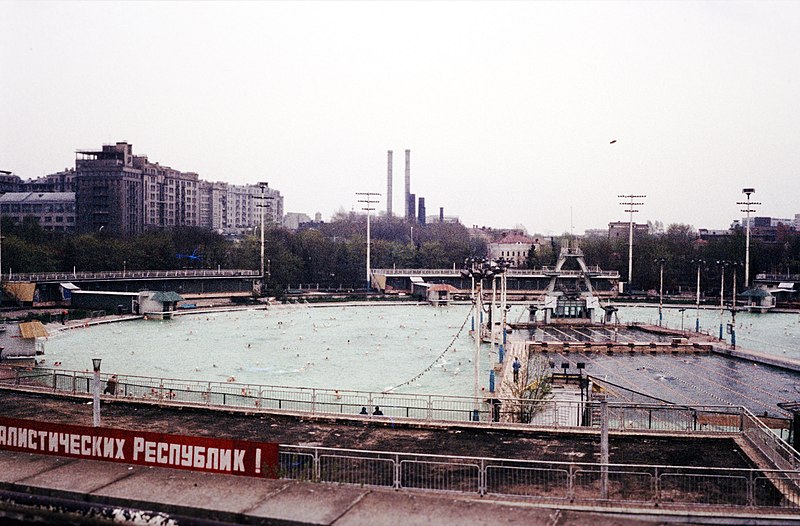
And, since Stalin was too busy murdering people (he killed 10 million people by starvation in the Ukraine in the 1930s, then set about annexing Poland, Lithuania, Latvia, and Estonia, followed of course by the Second World War, the aftermath of which required mass deportation of various populations to Siberia and Kazakhstan--he was a busy man), his grand plans for the Palace of the Soviets never were completed. The site fell into disrepair, and Khruschev later converted it to a large public swimming pool:
This woeful tale ends somewhat happily, as the Temple was reconstructed in the 1990s, after the collapse of the Soviet Union:
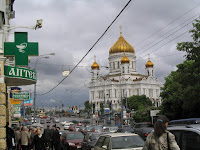
Ultimately, I must concede that while I enjoy a good mulled wine at the Warsaw Palace of Culture's Cafe Kulturalna, I understand Poles' mixed feelings about the structure--a clear symbol of Soviet power and all that comes along with it.
18 March 2009
Warsaw Landing
27 February 2009
Mystery Product
26 February 2009
Crisis on My Block
I have been transfixed by the latest news out of Europe, and I can't help but share my thoughts on the current economic climate.
Some commentators are calling Eastern Europe the "subprime market" of Europe. Over the past few years, investors from Western Europe clammored to invest in the rapidly-growing Eastern European countries, of which Poland is one of the most stable and prosperous.
The foreign investment is abundantly clear here. When I first arrived in Poland this summer, a banking executive told me that there are over 60 different bank brands in Warsaw, a city of 2.7 million inhabitants. Staggering. Poles have not historically availed themselves of banking services, creating a huge opportunity for foreign banks to offer accounts and sell products--including low interest loans in foreign currencies.
Which brings us to a key dynamic exacerbating the situation. Banks offered insanely low interest rate for Swiss franc- and Euro-denominated mortgage loans. The Polish zoty was very strong, peaking in the summer of 2008, and Poland was on track to join the Euro in 2012. Consumers figured they could save on interest in the meantime by paying in Swiss francs or Euro. But then the zloty started sliding, falling 48% against the Euro since the summer of 2008. Foreign currency became expensive, surprising borrowers whose mortgages suddenly became unaffordable. It was not just mortgage customers who couldn't pay back loans; many companies depend on foreign investment and loans which they now struggle to cover. I know of one bank which signed dozens of leases for branch locations, to be paid in then-inexpensive Euro. The bank has watched as their lease rates rise and rise as the Euro becomes pricier against the zloty.
The problem impacts all of Europe: since many of these loans were offered by foreign banks, mortgage and loan defaults harm business in countries other than Poland. Austria's banking industry is particularly at risk, since it is heavily exposed to Eastern Europe. So we end up with a situation where Polish consumers and businesses cannot pay back loans to Western European countries, who then stop investing in Poland, which means no more development, and no more new jobs. (Unemployment in Poland fell from 20% in 2004 to 9% in the fall of 2008, and has now increased to 10.5% in January 2009.)
I've been loooking around Warsaw and observing these dynamics very clearly in my everyday life. Even my not-so-humble abode in Warsaw is a microcosm of the larger market forces.
Here is the apartment building in which I live:

It is a new development--construction was completed in early 2008--consisting of a couple hundred fancy, modern condominiums. When I moved in in September of 2008, I was one of the only residents in the building. The building's manager told me that many of the units are owned by foreigners who bought the units as investments and planned to let them sit and accrue value. I have noticed a lot more construction in recent months, much to my annoyance. It appears that owners have decided to complete their units (Polish condos are sold incomplete, and owners install cabinets, flooring, etc) so they can either live there or rent them out.
Here is a street level view of my building:

You will notice here three banks:
Some commentators are calling Eastern Europe the "subprime market" of Europe. Over the past few years, investors from Western Europe clammored to invest in the rapidly-growing Eastern European countries, of which Poland is one of the most stable and prosperous.
The foreign investment is abundantly clear here. When I first arrived in Poland this summer, a banking executive told me that there are over 60 different bank brands in Warsaw, a city of 2.7 million inhabitants. Staggering. Poles have not historically availed themselves of banking services, creating a huge opportunity for foreign banks to offer accounts and sell products--including low interest loans in foreign currencies.
Which brings us to a key dynamic exacerbating the situation. Banks offered insanely low interest rate for Swiss franc- and Euro-denominated mortgage loans. The Polish zoty was very strong, peaking in the summer of 2008, and Poland was on track to join the Euro in 2012. Consumers figured they could save on interest in the meantime by paying in Swiss francs or Euro. But then the zloty started sliding, falling 48% against the Euro since the summer of 2008. Foreign currency became expensive, surprising borrowers whose mortgages suddenly became unaffordable. It was not just mortgage customers who couldn't pay back loans; many companies depend on foreign investment and loans which they now struggle to cover. I know of one bank which signed dozens of leases for branch locations, to be paid in then-inexpensive Euro. The bank has watched as their lease rates rise and rise as the Euro becomes pricier against the zloty.
The problem impacts all of Europe: since many of these loans were offered by foreign banks, mortgage and loan defaults harm business in countries other than Poland. Austria's banking industry is particularly at risk, since it is heavily exposed to Eastern Europe. So we end up with a situation where Polish consumers and businesses cannot pay back loans to Western European countries, who then stop investing in Poland, which means no more development, and no more new jobs. (Unemployment in Poland fell from 20% in 2004 to 9% in the fall of 2008, and has now increased to 10.5% in January 2009.)
I've been loooking around Warsaw and observing these dynamics very clearly in my everyday life. Even my not-so-humble abode in Warsaw is a microcosm of the larger market forces.
Here is the apartment building in which I live:
It is a new development--construction was completed in early 2008--consisting of a couple hundred fancy, modern condominiums. When I moved in in September of 2008, I was one of the only residents in the building. The building's manager told me that many of the units are owned by foreigners who bought the units as investments and planned to let them sit and accrue value. I have noticed a lot more construction in recent months, much to my annoyance. It appears that owners have decided to complete their units (Polish condos are sold incomplete, and owners install cabinets, flooring, etc) so they can either live there or rent them out.
Here is a street level view of my building:

You will notice here three banks:
- mBank is a virtual bank (customers conduct banking online and through SMS messages), owned by Polish BRE Bank, which is owned by German Commerzbank. BRE Bank is one of the first Polish banks, established in the late 1980s. As the first Polish bank to obtain a credit line in 1989, it helped Poland claw out from Communism's iron lock and spur the growth of capitalism.
- BPH is a Polish bank which is 66% owned by GE Money Bank--before that Italian bank UniCredit owned the majority share.
- ING, of course, is a Dutch bank.
24 February 2009
Milk Bar
Milk Bars are government-subsidized lunch restaurants created by Communists in the 1960s. When I first asked some Polish friends for restaurant recommendations, they enthusiastically urged me to go to a Milk Bar, described as "one step up from a soup kitchen." Each day, a list of food items and associated prices are posted (no profit is allowed, so prices fluctuate closely with commodity prices). You go up to a window and order from the never-English-speaking lady, then step down and collect your food from a cafeteria-style window. I finally went to a Milk Bar, and as you can probably guess....
I was yelled at in Polish. I apparently took another woman's Pierogi from the cafeteria window. Once I realized the yelling was directed at me, I froze and took a few slow steps backwards. I knew this was the correct action, as the yelling subsided and a huffy woman marched up to me and snatched the plate from my hands. I hope she understood my reason for stealing food at a government-supported soup kitchen. Honestly, I didn't mind paying the one dollar for my meal!
Photo: Milk Bar (Bar Mleczny) in 1982
I was yelled at in Polish. I apparently took another woman's Pierogi from the cafeteria window. Once I realized the yelling was directed at me, I froze and took a few slow steps backwards. I knew this was the correct action, as the yelling subsided and a huffy woman marched up to me and snatched the plate from my hands. I hope she understood my reason for stealing food at a government-supported soup kitchen. Honestly, I didn't mind paying the one dollar for my meal!
Photo: Milk Bar (Bar Mleczny) in 1982
Subscribe to:
Posts (Atom)